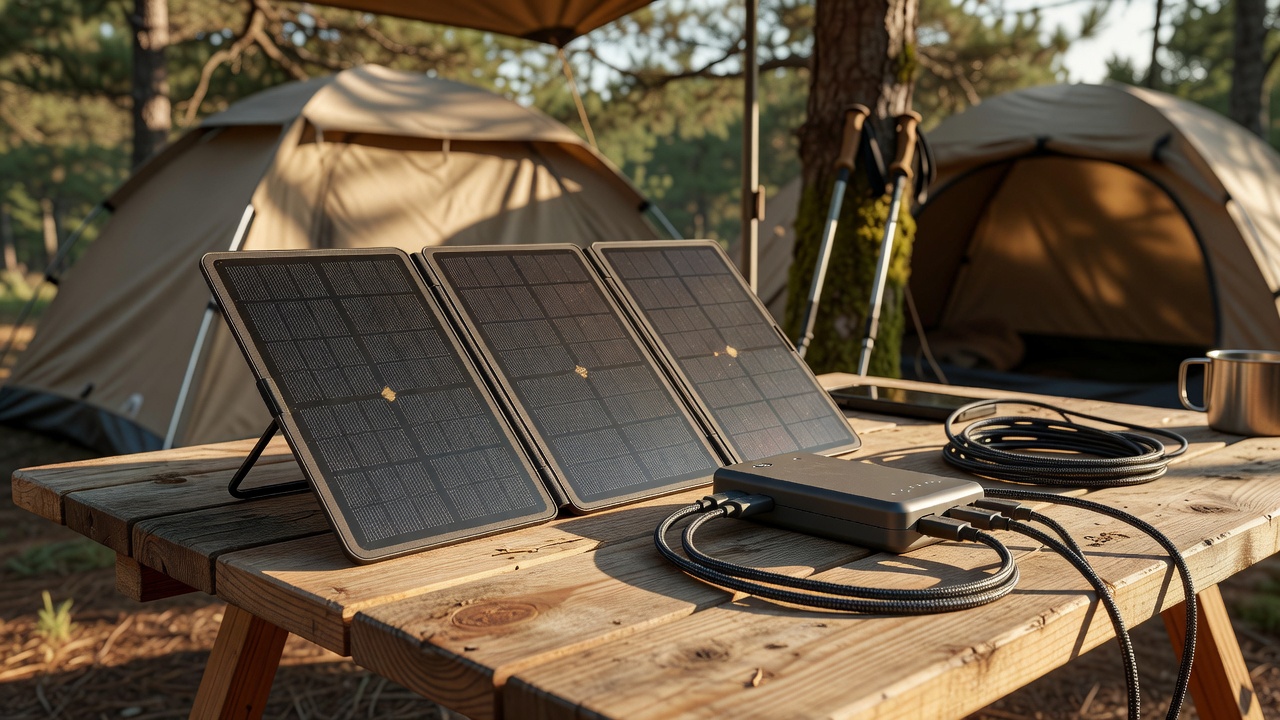
Start with an energy budget
Write down what you need to charge and why. A phone used briefly for photographs has a different demand from one recording navigation all day. A headlamp may use replaceable cells rather than USB. Check the actual equipment rather than buying around an advertised number of phone charges.
Watt-hours are a more useful comparison than milliamp-hours when batteries operate at different voltages. For a battery with a stated nominal voltage, watt-hours equal amp-hours multiplied by that voltage. A hypothetical 10,000 mAh pack rated at 3.7 V stores about 37 Wh nominally; that is not a promise of 37 Wh delivered through USB. Conversion, temperature and the device’s charging process reduce usable energy.
Charge essential devices before leaving home. Treat the panel as a supplement unless your own testing supports a more demanding plan. A small solar arrangement is not dependable emergency communication, and it should not be the only power provision for medical equipment.
Check every connection
Use a finished portable panel with a regulated output intended for the power bank you choose. Read both manuals. A matching connector shape does not prove matching voltage, charging protocol or available power. USB-C describes a connector; supported USB Power Delivery profiles still vary.
| Part | Confirm | Stop if |
|---|---|---|
| Panel output | Regulated output voltage and supported charging protocol | Only bare, unregulated leads are available |
| Power bank input | Accepted voltage, current and environmental limits | The required input is unclear |
| Cable | Correct connectors and sufficient power rating | Insulation, strain relief or contacts are damaged |
| Device | Manufacturer-approved charging requirements | Charging cycles repeatedly or becomes unusually hot |
Choose equipment with clear manufacturer information and relevant, verifiable safety compliance for your market. Do not salvage loose lithium cells, bypass a protection circuit or wire an improvised battery pack. Those are different projects with significantly different hazards.
Make a practical carry system
The reclaimed-material work belongs in the stand and organiser. A clean fabric roll can separate cables. A lightweight backing board can protect a folded panel in transit if the panel manufacturer permits it. Neither should obstruct ventilation, cover the active face or put pressure on fragile cells.
- Make an inventory. Label each cable with the equipment it serves. Remove adapters that solve no actual need.
- Dry-fit a support. Use the panel’s supplied stand first. If a simple external support is needed, round its edges and avoid drilling the panel or its frame.
- Provide strain relief. Leave slack at connectors and secure the cable to a suitable support without crushing it.
- Separate sun and storage. Place the panel in sunlight and the power bank in a dry, shaded, ventilated position within its operating limits.
- Pack for quick retrieval. Keep the bank and cable roll accessible so an approaching shower does not require emptying the whole bag.
Measure a useful afternoon
Begin with the power bank partly discharged and record its starting indication. Set the panel in unobstructed sunlight on a stable surface. Keep cables away from walking routes. If using a USB meter, ensure it supports the voltage and charging protocol of the complete system; the meter itself can affect operation.
Note cloud cover, shade and how often you reposition the panel. Rated panel power is measured under specified test conditions, not guaranteed throughout a campsite day. For illustration, an average usable input of 8 W over three hours corresponds to 24 Wh at that measurement point, before subsequent storage and output losses. This is arithmetic, not a forecast for your equipment.
Clouds can interrupt charging. Some combinations restart automatically; others need reconnection. Test this by observing normal changing conditions, not by exposing equipment to water or unsafe heat. Avoid charging a device through the power bank while the bank itself charges unless the manufacturer explicitly supports that mode.
Pack a sensible fallback
Repeat the test on a less favourable day. If the kit falls short, reduce demand, carry more charged capacity or choose a campsite with an appropriate charging option. Buying a larger panel is not always the lightest or cheapest answer. Keep an offline map and an appropriate non-phone navigation backup for your route.
Consult the USB Implementers Forum guidance on USB charging and Power Delivery for protocol context, but use your component manuals for actual limits. Ready.gov power-outage guidance offers wider preparedness context; this small campsite project is not a household backup system.